Giving back original treasures
Giving back original treasures
Terry D. Garcia, CEO of Exploration Ventures
I remember well my first glimpse of Machu Picchu. Hiking the Inca Trail, winding past the ruins of Winay Wayna and at last standing in the threshold of Intipunku, the Sun Gate, I looked down upon the citadel as an Inca traveler might have long ago. Surrounded by an ancient cloud forest, at times seeming to float above the clouds, it was stunning. As my friend, high altitude archaeologist Johan Reinhard once said “…Machu Picchu seem[s] like something out of a dream, an ancient city materializing out of the clouds… it is one of the few places in the world where reality can surpass one’s imagination.” Over the years as National Geographic’s chief science and exploration officer, I explored Peru’s extraordinary biological diversity and the many archaeological sites left by the ancient Andean cultures that ruled much of South America for thousands years. Their astounding architectural and artistic achievements are without rival. For a time, however, one place would be all consuming for me—Machu Picchu. It began with a call. In early 2000, I was contacted by a prominent Peruvian business leader and founder of the conservation organization Inkaterra, Jose Koechlin, who wanted to discuss Machu Picchu and artifacts that had been removed from the site some ninety years prior by Hiram Bingham the man credited with “rediscovering” Machu Picchu. It was widely assumed that National Geographic was in possession of the artifacts he explained. As far as I knew that was not the case, but I promised to investigate. I did not know it at the time, but I was about to embark upon a decade long journey. In the summer of 1911, Hiram Bingham, a professor of Latin American history at Yale University, set sail from New York for Peru. His objective was to find the fabled lost city of the Inca, Vilcabamba. According to Spanish chroniclers, Vilcabamba was “the town in which the Inca had his court and his armies and his primary temple… [and it was the refuge of] the last survivors of the race of the sun”. Upon arrival in Peru, Bingham and the expedition team made their way to Cusco and it was there Bingham heard rumors of ruins on a ridge above the Urubamba River some five days mule ride from Cusco. On the afternoon of July 24, 1911, guided by an eight-year-old boy who had told Bingham that he knew “where there are Inka houses…”, Bingham and a companion slowly made their way up the steep mountain and came upon the ruins of Machu Picchu. Bingham wrote later “ it took my breath away”.
Bingham spent a mere five hours at the site before continuing his journey but upon his return to the US, Bingham quickly began planning a return trip to Machu Picchu. He would eventually organize two additional expeditions in 1912 and 1914 to Peru. To fund his work, he sought the support of the National Geographic Society which agreed to co-sponsor with Yale the expeditions. For the National Geographic, Bingham’s expedition would constitute the organization’s first archaeological grant. On each of his expeditions Bingham excavated and harvested artifacts from Machu Picchu and the surrounding areas. Bingham, Yale, and National Geographic sought approval from the Peruvian government to export the artifacts to the United States for further scientific study. Peru eventually agreed to allow 74 boxes of artifacts to leave the country but only on the condition they be returned to Peru. Over the years, beginning in 1917, the Peruvian Government requested their return, but Yale delayed and resisted. For decades, the Machu Picchu artifacts would lay hidden from the world in the basement of the Yale Peabody Museum, despite periodic calls from international and Peruvian parties for their return. My team uncovered dozens of documents and correspondence which in clear and unambiguous language declared that the artifacts were the property of the Government of Peru and were only on loan. Our research further confirmed National Geographic did not, nor had it ever, physically possessed the artifacts but rather the entire collection was housed at Yale. Following this review, I worked with my friend Jose Koechlin and government officials to develop a plan for the return of the artifacts. We submitted a proposal to Yale at the end of 2001 under which Peru would be willing to provide Yale with a continuing loan to exhibit part of the Machu Picchu collection so long as Yale recognized Peru’s rightful ownership of the artifacts and the obligation to return them.
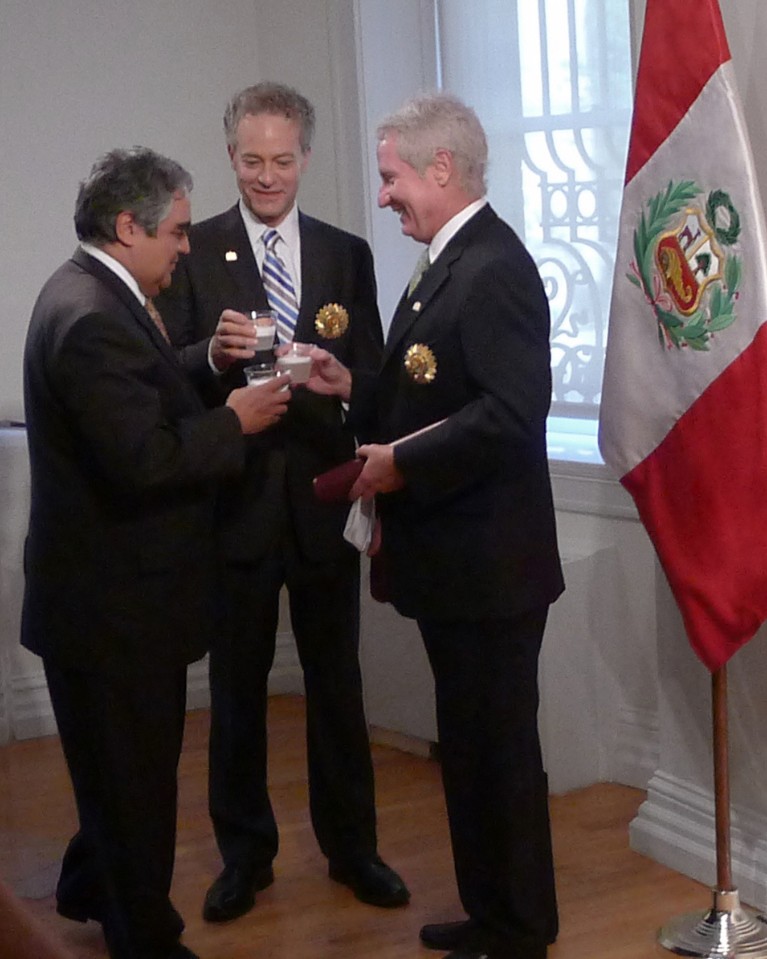
Yale initially expressed interest but after some preliminary conversations, we were told in no uncertain terms that Yale would not acknowledge title and moreover had no intention of returning the objects. My response was equally blunt, we had no intention of dropping the matter. In short order, the issue became a topic of major concern for successive Peruvian government administrations. Demonstrations demanding the return of the artifacts took place in Peru. Finally, the two parties began talks to resolve the dispute but quickly reached an impasse. As the dispute dragged on, demands for their return grew louder in Peru and the objects took on a powerful political symbolism. I continued to work behind the scenes with government officials on Peru’s evolving political and legal strategy. At every opportunity, whether a public event or a media interview, I called for the repatriation of the artifacts. In late 2009, I met with Peru’s then ambassador to the US and suggested a different strategy, one modeled on the successful approach developed by my friend, famed Egyptologist Dr Zahi Hawass that had led to the recovery of Egyptian cultural patrimony. Employing a tactic Zahi had used in the past to great effect, the government of Peru announced in early 2010, its intention to commence a criminal proceeding against Yale and its officials. Yale quickly expressed a newfound interest in settling the matter and in February 2011, a formal agreement was signed resolving the dispute and providing for the return of the artifacts. One month later, I joined Peruvian officials as the first of three shipments of artifacts arrived in Peru in time to celebrate the 100th anniversary of Bingham’s arrival at Machu Picchu. After almost 100 years, the artifacts excavated from Machu Picchu had returned home.
