Las Islas Encantadas
Las Islas Encantadas
Filippo Ricci, Creative Director of Stefano Ricci
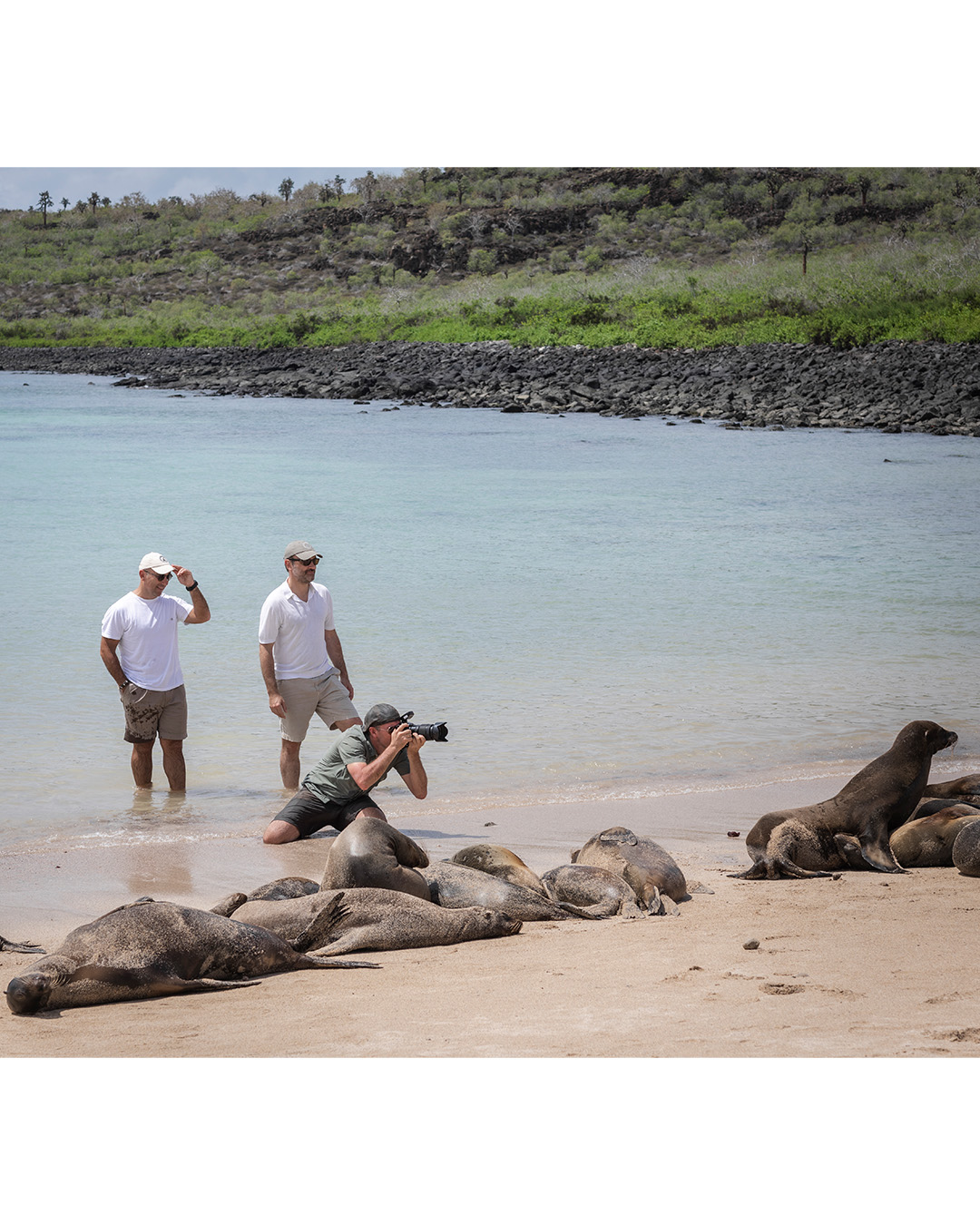
Las Islas Encantadas. Unspoiled nature. Experiencing the Galápagos Islands means immersing yourself in a micro-universe suspended in time. These islands are associated with Charles Darwin, but also Georgina Taylor, who noted down her own research in a manuscript in 1938 inspired by the book On the Origin of Species. We are Italians, we are Florentines. One of the stories I have reflected on in recent years, is that of a land of art and merchants which produced two explorers: Amerigo Vespucci and Giovanni da Verrazzano. The former gave his name to the Americas, the latter discovered the bay at the mouth of the Hudson River 500 years ago, which was to become the site of New Amsterdam and then New York. They achieved this by setting off from an inland city with no sea, just a small, untamed river. For our new chapter of Stefano Ricci Explorer we drew inspiration from all things connected with the sea, a labyrinth of nautical charts, research and calculation errors, without which many discoveries would never have been made. Ultimately, we chose the cradle in which the theory of the evolution of the species was born. We looked to Ecuador and, more specifically, the Galápagos Islands, a legendary place of dreams.
In 1831 Charles Darwin boarded the brig-sloop HMS Beagle for a scientific reconnaissance expedition. He was 21 years old and remained on board for five years, during which time he managed to complete geological and biological observations. Specifically, during his stay on the Galápagos Islands, he discovered differences in the anatomical structure and dietary habits between similar animals (tortoises, thrushes and finches). He developed his own theory, basing it on the struggle for existence. Common ancestors who, under evolutionary pressure, are now the offspring of natural selection. He was considered a heretic for decades because of this, and while it is certainly not up to us to enter into a discussion to this effect, we should take a closer look at focal points on which to reflect. Pope Francis says that the Big Bang was not the result of chaos. It is difficult to believe that life, animal or vegetable, was created from chaos, even if many questions still remain unanswered to this day. What is certain is the love for creation here is not a slogan at the service of sustainability. Through their work, the West discovered the story of Temujin, son of Yesügei the Brave and Princess Ho’ Elun. The boy was orphaned at a young age (his father was poisoned as an act of revenge). According to legend, he was a descendant of The Blue Wolf. What we know for sure is that in 1206, during a meeting of the heads of steppe tribes, he was elected Genghis Khan – universal ruler – thus entrusted with political, military, and spiritual power over the “people who live in felt tents”. He was able to unite competing powers, such as the Kyrgyz from Siberia, the Uighurs from Sinkiang, and the Kara-Khitans from Manchuria. All these groups under his rule rebelled against the neighbouring dominions. The Mongols (who took their name from the eponymous tribe) rose to power after the conquest of Beijing in 1215 and Samarkand in 1220. Genghis Khan’s vision united a territory spanning from the Yellow River to the Ural Mountains.

In creating this project, I had the pleasure of sharing with Niccolò, my brother, the thrill of ongoing research in the field. We were immersed in a habitat which, from Las Grietas to El Garrapatero, from Santa Fe to Bahía Bowditch, accompanied us until we achieved a true sense of exploration, encountering iguanas, sea lions, sharks and unspoiled nature. We did this in collaboration with the Charles Darwin Foundation, the premier research institution dedicated to the conservation and sustainable development of the Galápagos Islands. It was an experience that will remain etched in our hearts. When thinking about the great scientist, it was natural to draw a parallel with another man of science from our Tuscan homeland: Galileo Galilei. His theories on the movement of asteroids were opposed five centuries ago by the advocates of dogma. Who knows what the future holds for us. But we all have one responsibility: taking care of the planet, committing to sustainability and the future of the species. A mission that we have proudly advanced for our children and grandchildren.
