My Cambodia
My Cambodia
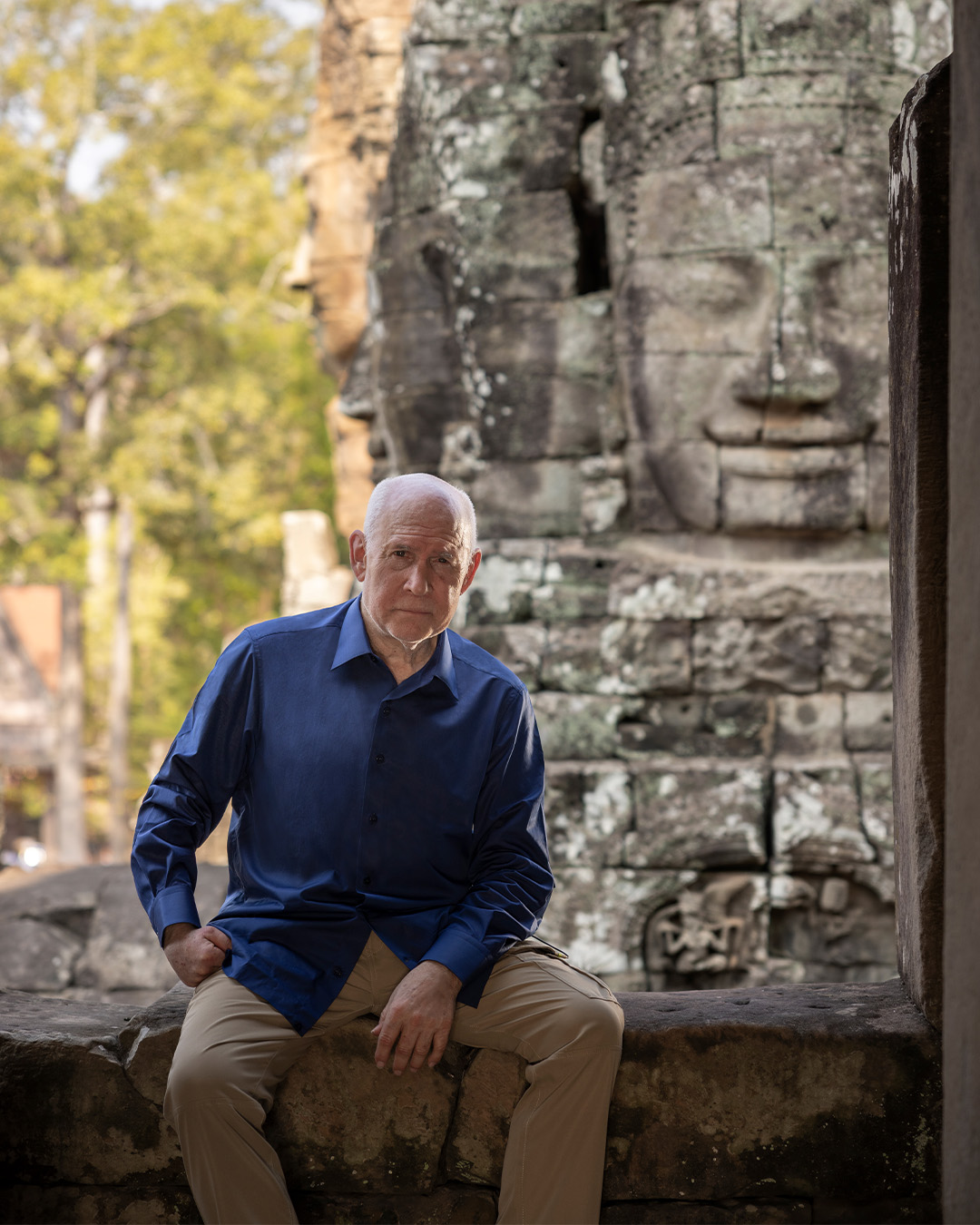
Steve McCurry, Renowned Photographer and Visual Storyteller
I have always found Angkor Wat to be a mystical, magical place that saturates the senses, leaving one with a sense of insignificance while being awed by an indescribable example of human accomplishment. My first journey to Angkor Wat in the late-1990s, during the monsoon season, presented both numerous challenges and incredible opportunities. The dirt road leading to the site was riddled with large potholes, and accommodation was scarce, with only one hotel available. Making phone calls required trekking to a distant shed. Despite all the logistical difficulties, the ruins were filled with the laughter of children playing among the deserted and eerily empty structures, where once bustling villages and monasteries thrived. Some temples were obscured by dense vegetation, necessitating chopping and hacking through the flora to access them. An unexpected encounter with a monkey resulted in a trip to the hospital for rabies shots, adding to the adventure. Despite the gloomy atmosphere, dancers, musicians, and other alms seekers occasionally appeared, highlighting the enduring life amidst desolation. However, the serene processions of monks silently collecting alms provided a predictable rhythm of life.
The glorious and breathtaking Buddhist temple complex of Angkor Wat has dominated a Cambodian plain for eight centuries and has survived despite the monsoon, drought, neglect, plunder, ill-conceived restoration attempts, and decades of war. It is simply the largest and most spectacular ancient temple complex on earth, its glory reflective of heavenly grandeur. If, as Goethe said, architecture is frozen music, then Angkor Wat is a celestial symphony. Its magnificence reveals the brilliance of its ancient architects, craftsmen, and builders who strictly adhered to an aesthetic of symmetry so that the temples are mirror images constructed on an East-West axis of the main causeway. Constructed in the 12th century by tens of thousands of workers, it was the center of the Khmer Dynasties in the early fifteenth century. Originally a Hindu temple complex, it became a Buddhist temple by the end of the century. It was António da Madalena, a Portuguese Capuchin friar, who was the first European to visit in 1586. He reported on his journey to a historian of the Archives of Portuguese exploration-colonization in Asia. Henri Mouhot, (1826 -1852) a French naturalist and explorer, has often been given credit for “discovering Angkor Wat, but it was never really lost. His contributions, however, were detailed sketches and eloquent descriptions which brought the ruins to the world’s attention. He wrote: “One of these temples—a rival to that of Solomon, and erected by some ancient Michaelangelo—might take an honorable place beside our most beautiful buildings. It is grander than anything left to us by Greece or Rome…” Tended for centuries by a handful of monks, the temple areas are now lively places inhabited by 100,000 people, fueled by the ever-growing numbers of visitors from around the world, providing jobs, and some measure of prosperity for the surrounding inhabitants.


The preeminent national symbol, Angkor Wat gives the country pride in its history, identity, and place. A chimerical fusion of aspiration and devotion, the temple complex has been called the Eighth Wonder of the World. No settlement can grow and thrive without a reliable source of water so from the beginning, meticulous planning ensured that water would be central to the development of Angkor, which is often described as a “hydraulic city.” Channels and reservoirs were constructed to collect and store water coming from the hills, both for flood control and for irrigation for agriculture and rice cultivation. The grandeur of the city was planned and constructed for eternity by Suryavarman II, the ruler who may have planned it for his burial site. Visitors and pilgrims from around the world travel to experience one of the world's greatest masterpieces and are greeted not only by the awe-inspiring architecture but also by the vibrant mosaic of life that surrounds it which breathes life into these ancient stones. As archaeologists and restoration experts from around the world strive to save this complex for the next millennium, Angkor Wat again becomes a place to live and work, observe a vibrant faith and marvel. Somerset Maugham, the British playwright, and novelist, summed up Angkor Wat, “I have not seen anything in the world more beautiful than the temples at Angkor.” As the modern traveler, writer, and chef, Anthony Bourdain opined, “It's an irritating reality that many places and events defy description. Angkor Wat and Machu Picchu seem to demand silence, like a love affair you can never talk about”.
